
Infinity Energy Services is an MCS-certified heat pump installer based at Swanwick, near Southampton, covering the whole of Hampshire. We design and fit Vaillant and Grant air source heat pumps, apply for your Boiler Upgrade Scheme grant – £7,500, or £9,000 if you’re replacing oil or LPG – and take it straight off your invoice.
Thinking about replacing an ageing gas boiler? Tired of watching the oil tank empty every winter? Or just wondering whether a heat pump would actually work in your home?
This page answers those questions for Hampshire homes specifically: what the grant is worth to you, what we check before recommending a heat pump, how planning rules and the local grid affect the job, and what happens between your first call and a warm house.
If you’d rather talk it through, call us on 0800 909 8882.
TABLE OF CONTENTS
Why Hampshire Homeowners Choose Infinity for Their Heat Pump
Hampshire is our home county. Infinity Energy Services was founded in 2011 by Daniel Hanslip, and we’re headquartered at Unit 6 Swanwick Business Centre, between Southampton and Fareham. So wherever you are in the county, we’re never far away.
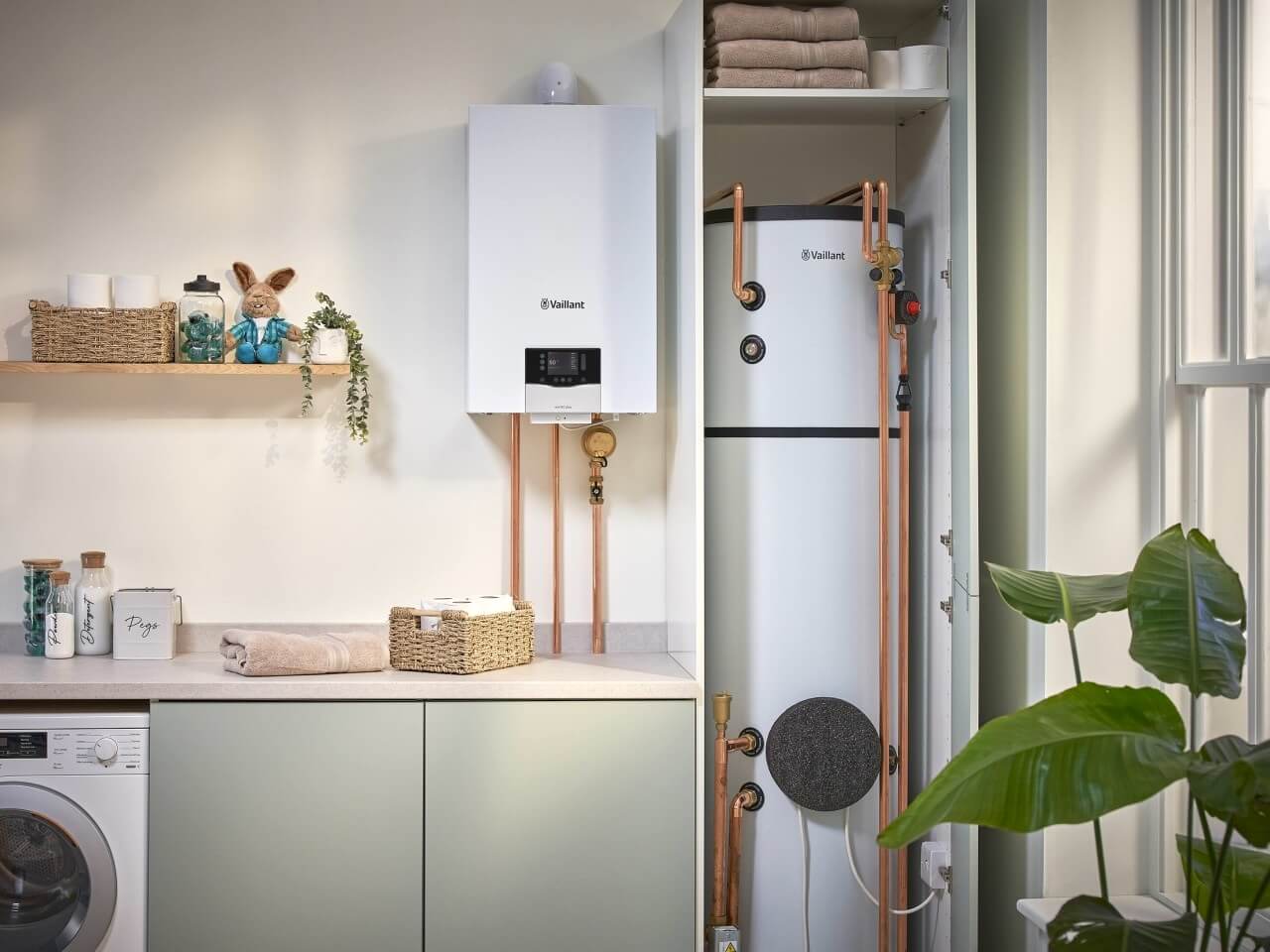
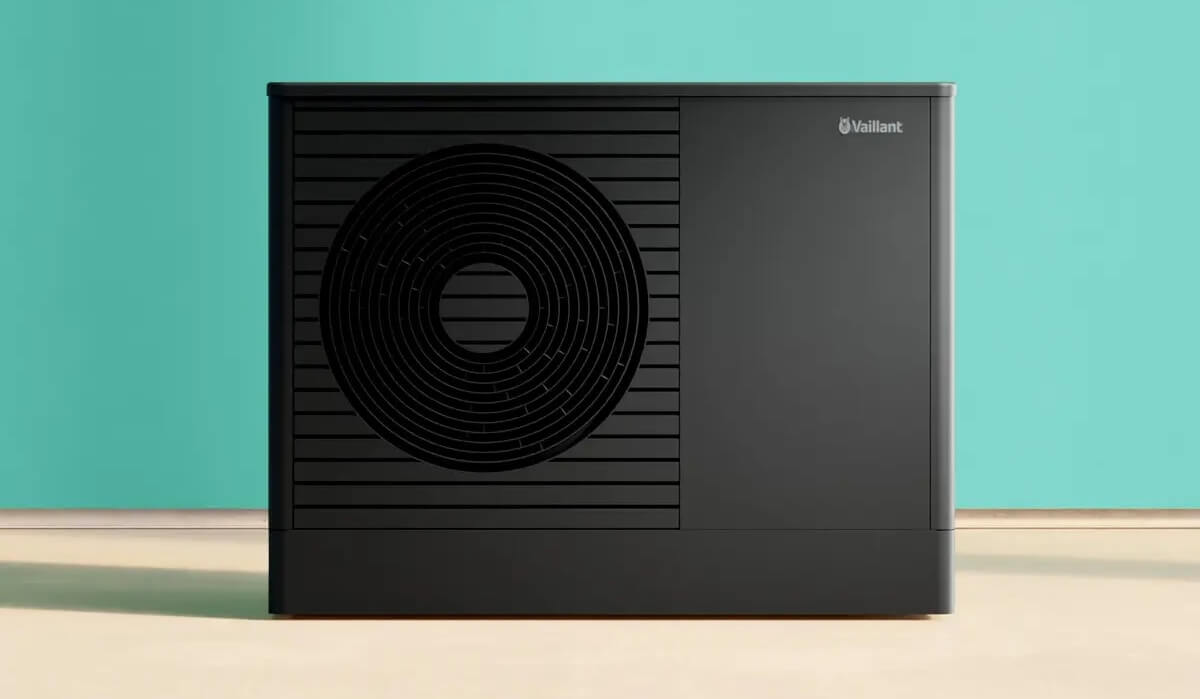
We aren’t tied to one manufacturer. We generally fit two air source heat pump ranges – the Vaillant aroTHERM plus and the Grant Aerona 290 – and we recommend one or the other after we’ve worked out your home’s heat loss, not before.
And because we also install solar panels, battery storage and EV chargers, we can design your heating as part of the whole home, which is useful if you want to cut your electricity bill as well as your heating bill.

Our accreditations
- MCS-certified for air source heat pumps – the certification that lets us apply for the Boiler Upgrade Scheme grant on your behalf.
- RECC member – consumer-code protection for renewable energy contracts.
- NICEIC and NAPIT registered – electrical competence for the wiring your heat pump needs.
- TrustMark registered – the government-endorsed quality scheme.
- CHAS accredited – health and safety standards for site work.
Call 0800 909 8882
with any questions or for expert advice
Is a Heat Pump Right for Your Hampshire Home?
Most homes can take a heat pump. The real question is what – if anything – needs doing first, and that’s exactly what our survey is for.
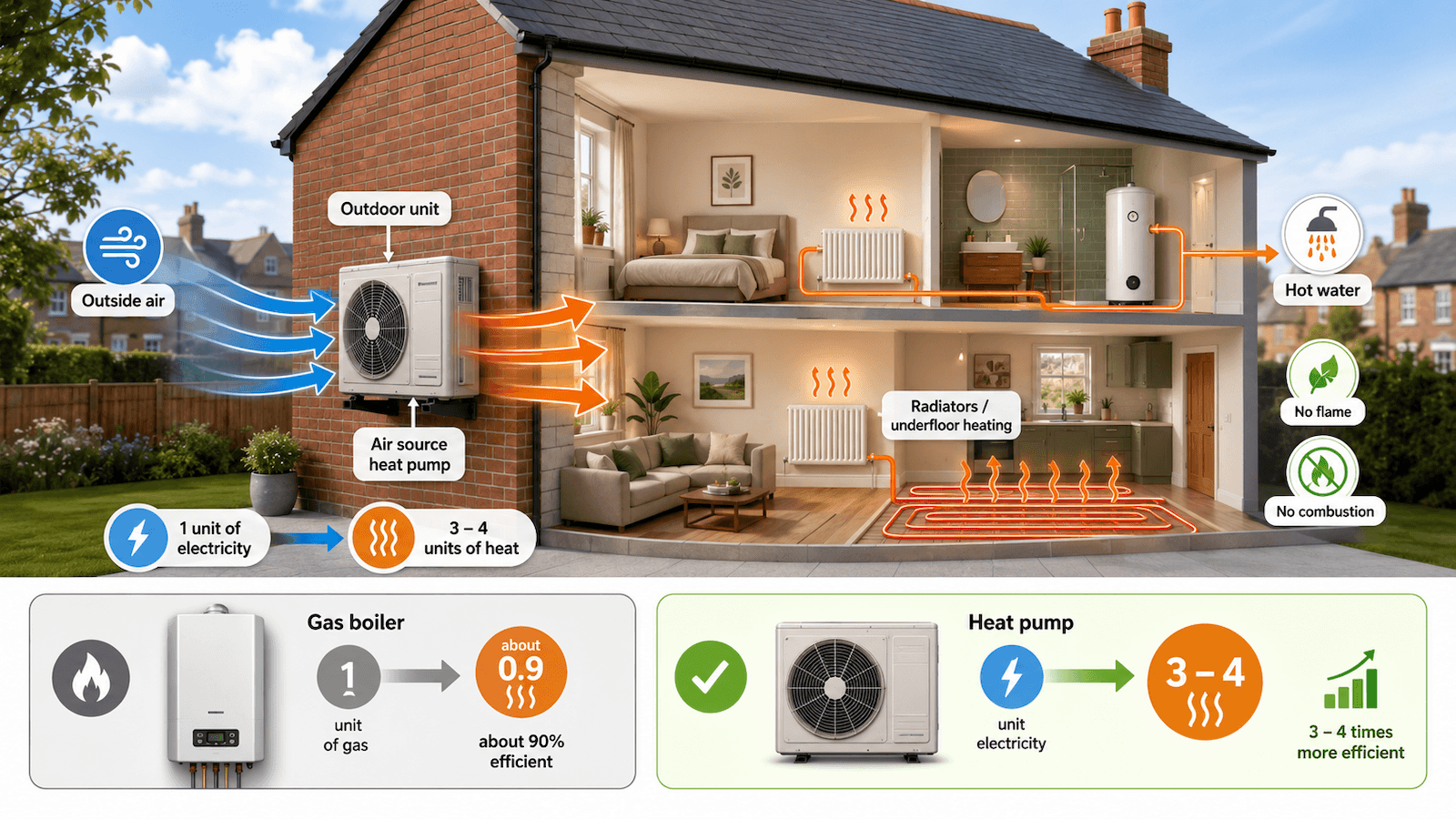
An air source heat pump works like your fridge in reverse. Instead of pulling heat out of a box, it pulls heat out of the outside air and pumps it into your radiators and hot water cylinder.
It runs on electricity, but it moves heat rather than making it. That’s the trick: for every 1 kWh of electricity it uses, a well-designed system delivers roughly 3-4 kWh of heat. Engineers call that ratio the ‘coefficient of performance’, or COP.
A heat pump also likes to run steadily at a lower water temperature, rather than blasting heat for an hour like a boiler. It’s a different rhythm, and we’ll show you how to get the best from it.
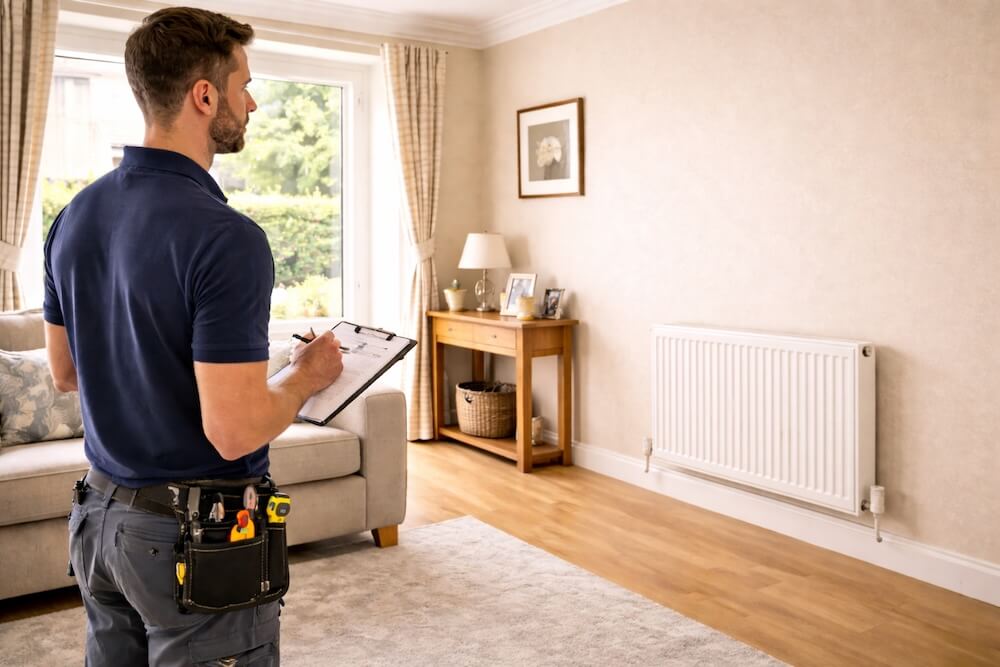
Six things we check at your survey
- Heat loss, room by room. This is the number that decides what size of heat pump you need – not the number of bedrooms.
- Insulation. Loft and cavity wall insulation make a heat pump cheaper to run. If something is worth doing first, we’ll tell you.
- Radiators. A heat pump runs best at a lower flow temperature than a boiler, so some radiators may need upsizing. Both heat pumps we fit can reach 75 °C if needed, which helps in older homes.
- Hot water. You’ll need a hot water cylinder. If you have a combi boiler now, we’ll find the space for one.
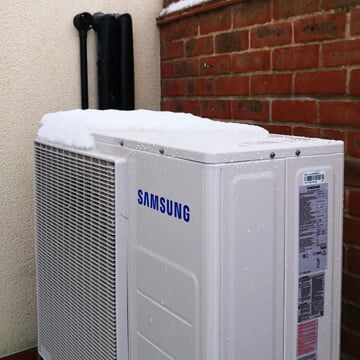
- Outdoor space. The unit needs a spot with good airflow, usually against an outside wall or on the ground close by.
- Electrics. We check your consumer unit and supply, and we handle the notification to the local network operator, if required.
The Hampshire homes we see most often
Victorian and Edwardian terraces in Southampton and in Portsmouth and Southsea often have solid walls and small back gardens. They work well with a heat pump, but siting the unit for noise needs care and some radiators usually need upsizing.
Post-war and 1960s-1970s homes in towns such as Basingstoke, Andover and Havant usually have cavity walls that can be insulated. They’re often straightforward candidates for a heat pump.
Rural houses, farmhouses and barn conversions are where the biggest changes happen, especially if they’re heated by oil or LPG. Higher heat loss can mean a larger unit.
Flats and maisonettes follow different planning rules and have less space for a cylinder and an outdoor unit. Ask us – we’ll tell you whether it’s practical.
The Boiler Upgrade Scheme in Hampshire: £7,500 or £9,000
The Boiler Upgrade Scheme (BUS) is the government grant for swapping fossil fuel heating for a heat pump in England and Wales. It isn’t means-tested, and you don’t apply for it yourself – as your MCS-certified installer, we do that for you.
How much you get depends on how your home is heated now. Here are the current figures from GOV.UK:
The £9,000 is the standard £7,500 plus an extra £1,500 for homes heated by oil or LPG that don’t have a mains gas connection. That extra £1,500 is available until March 2027. For every grant level, including the £2,500 grant for air-to-air heat pumps, and the mistakes that can cost you the grant, see our guide to the Boiler Upgrade Scheme.
Who qualifies
- You own the property – including second homes and homes you rent out.
- The heat pump replaces fossil fuel or electric heating: oil, gas, LPG or electric.
- It’s a full heat pump system, not a hybrid with a boiler.
- The property hasn’t already had government funding for a heat pump. Only one grant is allowed per property.
- Most new-build homes and social housing don’t qualify.
How the grant works with us
Once you’ve accepted our quote, we apply to Ofgem for your grant voucher. Ofgem emails you to confirm you’re happy for us to go ahead – one click – and the grant comes straight off your invoice. No forms to fill in, and no money to claim back.
Important: once your application is approved, the scheme rules give your installer three months to finish the installation (Ofgem). We plan your installation date before we apply, so the voucher doesn’t run out.
0% VAT until 31 March 2027
Heat pumps installed in homes are currently zero-rated for VAT, on both the equipment and the labour. According to HMRC, that runs until 31 March 2027; from 1 April 2027 the rate goes up to 5%.
Important: if your home runs on oil or LPG, the extra £1,500 and the 0% VAT both currently end in spring 2027. The sooner you book a survey, the more comfortably your installation fits inside both.
Wondering which grants and incentives you are eligible for?
Select your location to discover what support you are entitled to for home energy technologies.
Covers the UK · Free to use · No obligation
What Does a Heat Pump Cost to Install and Run in Hampshire?
We don’t put a one-size price on this page, because the right system depends on your home’s heat loss. What we do promise is a fixed, itemised quote after a free survey, with your grant already taken off.
Your quote will depend on:
- the size of heat pump your home needs
- the hot water cylinder
- any radiators that need upsizing
- pipework changes
- any electrical work at your consumer unit
Removing and safely disposing of your old boiler is part of the job, so you don’t need to arrange it separately.
Running costs: the sum that matters
Running costs come down to two things: how much heat your home needs, and how efficiently that heat is made.
WORKED EXAMPLE
Say your home needs 12,000 kWh of heat a year for heating and hot water.
- A heat pump running at a seasonal efficiency of 3.5 would use about 3,430 kWh of electricity to deliver it (12,000 ÷ 3.5).
- An oil boiler running at, say, 85% efficiency would burn about 14,120 kWh of oil to deliver the same heat (12,000 ÷ 0.85).
Which one is cheaper then depends on what you pay per kWh for electricity and for oil, gas or LPG – and on your tariff. Heat pump owners can often save by using a cheaper off-peak or heat pump tariff.
Please note: the efficiency figures on a heat pump datasheet are measured in lab conditions. Real-world seasonal efficiency depends on design and is usually a little lower – which is why the heat loss survey and radiator sizing matter so much.
The calculator below does the sum for you with today’s energy prices.
How do you heat your home today?
Select your current heating, and discover heat pump installation and running costs compared to what you have now, and any grants you can claim.
Free to use · Grants checked against official schemes · No obligation
Note: a heat pump running partly on your own solar electricity costs even less to run. If you’re thinking about panels too, see our guides to solar panel installation in Hampshire and solar batteries in Hampshire.
Vaillant or Grant? The Two Heat Pumps We Install Most in Hampshire
Both are ‘monobloc’ air source heat pumps: everything sits in one sealed outdoor unit, connected to your heating by water pipes. Both use R290, a natural refrigerant with a global warming potential of 3, compared with 675 for the R32 refrigerant used in many older heat pumps.
Here’s how they compare.
Warranty terms and conditions apply. We’ll tell you which unit suits your home – and why – once we’ve done the heat loss survey.
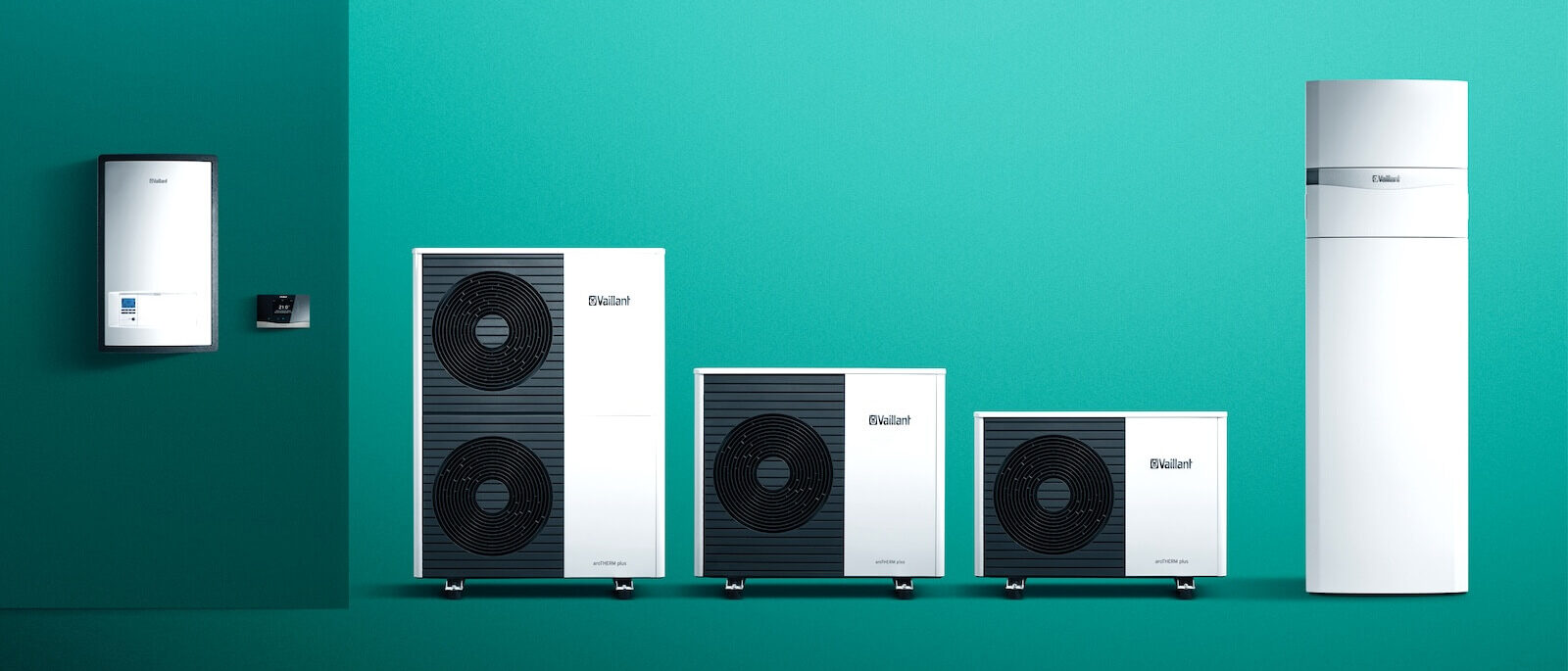
Vaillant heat pump installation in Hampshire – our in-depth guide to the aroTHERM plus, sizes and running costs. Or read our installer’s review of the 2026 aroTHERM plus range.
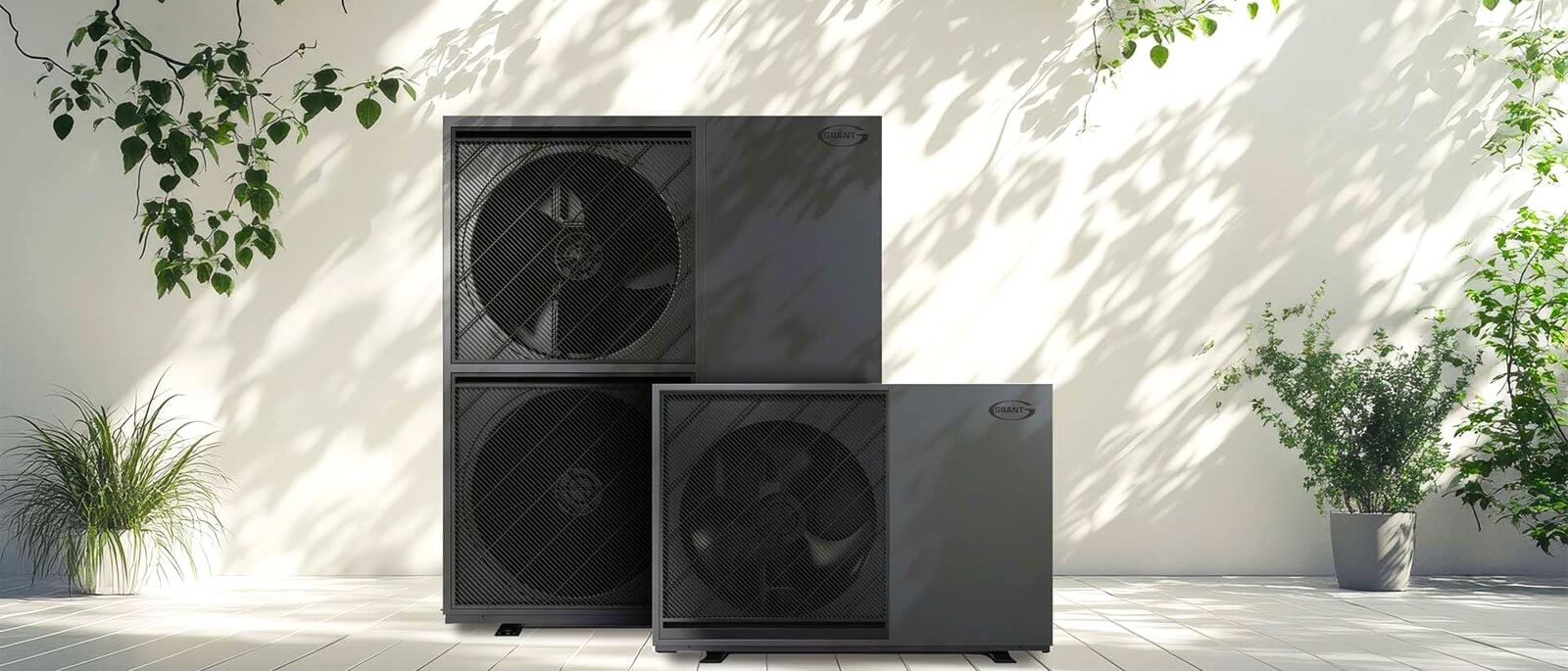
Grant heat pump installation in Hampshire – the Aerona 290 range in detail, with a worked example for an oil-heated home.
Hampshire-Specific Things We Check
Off the gas grid: oil and LPG homes
If you live in one of Hampshire’s rural villages – in the New Forest, the Test Valley or the Meon Valley, say – there’s a fair chance your home runs on oil or LPG rather than mains gas.
That matters twice over. First, you’re likely to qualify for the £9,000 grant rather than £7,500. Second, oil and LPG homes usually see the biggest difference in running costs when they switch to a heat pump.
If you’re replacing an oil boiler, we’ll also talk you through what to do with your old oil tank.

Planning permission
Most air source heat pumps on houses in England are ‘permitted development’, which means you don’t need to apply for planning permission. The rules were relaxed in 2025. According to the government’s impact assessment:
- the old rule that the unit had to be at least 1 metre from your boundary has gone
- detached houses can now have two heat pumps rather than one
- each outdoor unit can be up to 1.5 m³, up from 0.6 m³
The unit still has to meet the MCS 020(a) noise standard, which we calculate for your property at the survey.
Please note: listed buildings need listed building consent. Conservation areas and the New Forest and South Downs National Parks have extra restrictions on where the unit can go – and inside the two national parks, the park authority is the planning authority. We check which rules apply to your address before we design anything.
Close to the coast
Salty sea air is harder on outdoor units. If you’re near the water – Southsea, Hayling Island, Lymington or Milford on Sea, for example – we follow the manufacturer’s guidance on siting and protecting the unit.
The local grid: SSEN
SSEN is the electricity network operator for Hampshire. Heat pumps have to be notified to the network operator, and some need approval before they’re connected. We handle that paperwork for you.
How Your Heat Pump Installation Works
Every Infinity heat pump installation follows the same five steps.
Two Hampshire Heat Pump Installations
Southampton: air source heat pump and solar panels
Mr and Mrs Jenkins in Southampton wanted lower energy bills and a smaller carbon footprint, so we installed an air source heat pump alongside solar panels.
Before the installation, they used around 20,711 kWh of gas and electricity a year, costing £1,710.61. Afterwards, their usage fell to 8,066 kWh and their energy bill to £517.51 – a saving of £1,193.10 a year (£1,710.61 − £517.51).
Please note: that saving comes from the heat pump and the solar panels together. The installation was done when the grant was £5,000, and energy prices have changed since – so treat it as a real example, not a forecast for your home.
Past project: ground source heat pumps for a large oil-heated Hampshire home
This customer’s large Hampshire home – 608 m² of floor area – was heated by oil boilers. We installed four Kensa Evo ground source heat pumps (three 13 kW units and one 7 kW unit), with a horizontal ground loop of around 4,500 metres of buried pipework, two 250-litre cylinders and a 500-litre buffer tank.
The household’s heating carbon emissions were predicted to fall from 65,610 kg of CO2 a year to 9,131 kg – a reduction of 86%.
See more of our heat pump case studies.
What our customers say
Warranties, Servicing and Aftercare
Vaillant aroTHERM plus: up to a 7-year manufacturer warranty when it’s paired with a Vaillant cylinder.
Grant Aerona 290: a 7-year manufacturer guarantee when it’s fitted by an accredited Grant G1 installer with a Grant Mag One DUO magnetic filter. Both come as standard with us.
Warranty terms and conditions apply in both cases.
Important: a heat pump needs a yearly service to keep it running efficiently and safely, and to keep the manufacturer guarantee valid. That’s the main bit of upkeep – there’s no flue, no combustion and no annual gas safety check.
A well-maintained heat pump should typically last 15-20 years.
As members of the Renewable Energy Consumer Code (RECC), we also give you the consumer protections that come with it, including insurance-backed deposit protection and workmanship guarantees.
Heat Pump Installation Across Hampshire
We install heat pumps across the whole of Hampshire – the SO and PO postcodes around Southampton, Winchester, Portsmouth and Fareham, and the RG, GU, SP and BH postcodes around Basingstoke, Aldershot, Andover and Ringwood.
These towns have their own heat pump pages:
We also install regularly in Havant, Waterlooville, Romsey, Petersfield, Lymington, Ringwood, Alton and Fleet, and if your address is anywhere inside the county boundary, we cover you.
Frequently Asked Questions About Heat Pumps in Hampshire
The Boiler Upgrade Scheme gives £7,500 towards an air source heat pump. If your home is heated by oil or LPG and has no mains gas connection, you get an extra £1,500 – £9,000 in total – until March 2027. We apply for it for you, and it comes straight off your invoice.
Often, yes. Both the Vaillant aroTHERM plus and the Grant Aerona 290 can reach flow temperatures of up to 75 °C. Our survey checks every radiator against a room-by-room heat loss calculation. If any need upsizing, we explain why and include the cost in your quote.
Usually not. Most air source heat pumps on houses in England are permitted development, provided the unit meets the MCS 020(a) noise standard and the size limits. Listed buildings need consent, and conservation areas and the New Forest and South Downs National Parks have extra restrictions. We check your address before we design anything.
A typical air source heat pump installation takes 3-5 days. Jobs with a new cylinder and extensive pipework changes can take a day or two longer.
Yes. Both heat pumps we install keep heating your home in outdoor temperatures as low as -25 °C – far colder than a Hampshire winter gets. Even very cold air still holds plenty of heat for a well-designed heat pump to use.
Modern units are quiet – both the Vaillant aroTHERM plus and the Grant Aerona 290 hold Quiet Mark accreditation. For permitted development, the installation also has to meet the MCS 020(a) noise standard at your neighbours’ windows, which we calculate at the survey.
It can be, but the savings are usually smaller than for oil or LPG homes, because gas is a cheaper fuel per kWh. A well-designed system, a heat pump tariff and – ideally – solar panels make the biggest difference. Our heat pump savings calculator compares your current heating with a heat pump using today’s prices.
Yes, and we often do. Your heat pump can run partly on your own solar electricity, and a battery lets you use more of it in the evening or charge up on cheap overnight rates. Because we install all three, we can design them to work together.
If you’re inside the county boundary, yes – from Southampton, Portsmouth and the New Forest to Basingstoke, Andover, Petersfield and Aldershot. We’re based at Swanwick, between Southampton and Fareham.
Book a Free Heat Pump Survey in Hampshire
Want to know what a heat pump would cost for your home, and which grant you’d get? Fill in the form for a free survey, a no-obligation quote, or a second opinion on a quote you already have.
Call 0800 909 8882
with any questions or for expert advice
What happens next
- We get in touch to talk about your home and how it’s heated now.
- A qualified surveyor carries out a free heat loss survey.
- You get a fixed, itemised quote with your grant already deducted.
We cover the whole of Hampshire from our headquarters at Unit 6 Swanwick Business Centre, Bridge Road, Southampton SO31 7GB.