Infinity Energy Services designs and installs solar panels for businesses across Hampshire and the South from our base at Swanwick, between Southampton and Fareham.
We have been doing it since 2011, for factories, warehouses, farms, offices and public bodies.
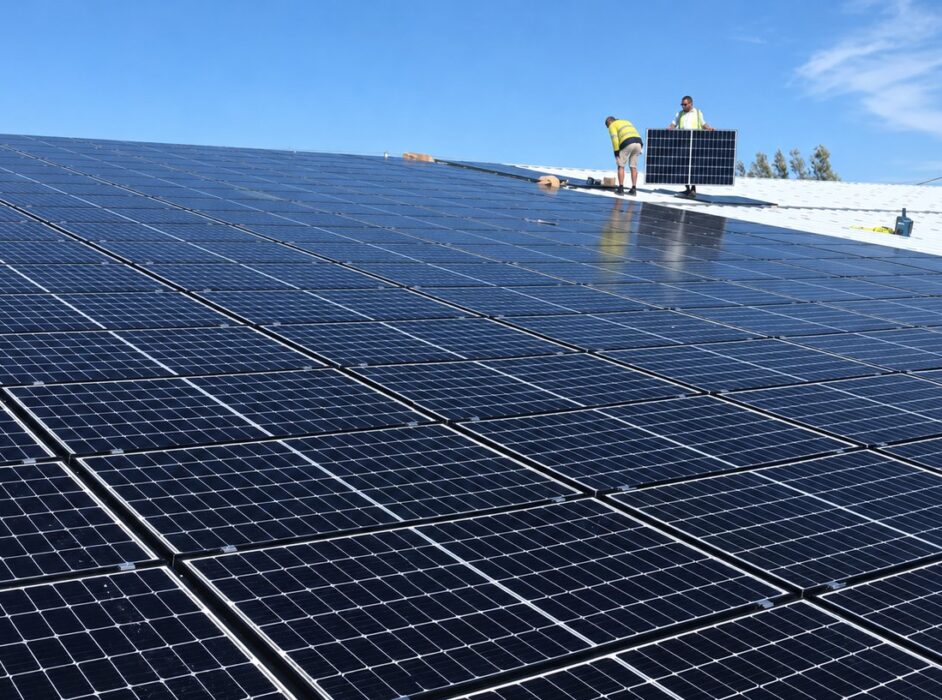
The projects speak for themselves: a 404.3 kWp system for Novatech in Portsmouth that is on course for a return of over £1,000,000, a 239.4 kWp system saving Ahmarra over £26,000 a year, and an 82.24 kWp system for the Coastguard in Southampton.
This page explains how a commercial solar project runs, what it costs and pays back, and where we work.
If your premises are in Hampshire, our commercial solar in Hampshire page has local detail and budget figures; farms and rural businesses have their own solar for farms page.
Call 0800 909 8882
to arrange a free site survey or contact us online
Why Infinity for commercial solar?
- Commercial solar installer since 2011, based in Hampshire
- Best Regional Installer – Energy Efficiency Awards 2023, 2024 and 2026
- MCS-certified; Tesla Premium Installer for battery storage
- Free site survey and a fixed written proposal with payback figures
- References from previous commercial clients on request
Commercial solar projects we have delivered

Novatech
A 404.3 kWp rooftop system for a manufacturer with a large daytime load. On the agreed figures it is on course for a return of over £1,000,000 over the life of the system.
Ahmarra
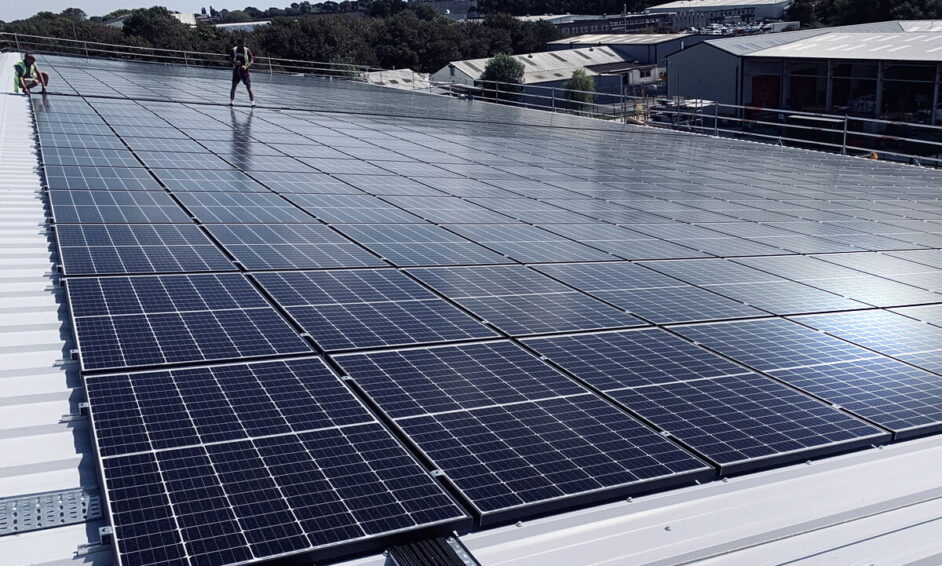
A 239.4 kWp system that cut the company’s electricity bill by more than £26,000 a year, with the surplus exported to the grid.

DKW Engineering
An engineering firm saving around £6,000 a year in electricity, with the system paying for itself in a little over six years.
We have also installed systems for the Maritime and Coastguard Agency, PSV Glass and the Coastguard in Southampton (82.24 kWp, about £8,000 a year). See the commercial case studies.
How a commercial solar project runs
1. Energy audit
We start with your bills and, where you have one, your half-hourly electricity profile: how much you use, when, and what you pay decide the size of system worth building.
2. Site survey
We measure and inspect the roofs or land, the roof coverings and structure, the incoming supply and the distribution boards; flat, pitched and ground-mounted each have their own answers.
3. Design and proposal
Your buildings are modelled in PV*SOL and the system designed around your load. The proposal sets out the system, cost, expected generation, savings and payback, so the decision can go to your board on numbers.
4. Grid and planning
Commercial systems need the district network operator’s agreement to connect, and we make that application for you; it usually sets the timetable. Smaller rooftop systems are permitted development, larger ones generally need the council’s prior approval and ground-mounted arrays need planning permission; we tell you which applies and can help with the application.

5. Installation
Method statements, risk assessments and access are agreed with you before anyone arrives, and the work is planned around your operation so it keeps running. Deliveries, scaffolding and any crane lifts are scheduled with your site manager.
6. Handover and after-care
Your staff are shown the shut-down procedure and the monitoring portal, and you receive a full handover pack with the drawings, certificates and warranties. We watch the same monitoring you do, so a fault is spotted early.
What commercial solar costs and pays back
The price of a commercial system depends on its size, the roof or ground it sits on and the electrical work needed to connect it, so every proposal is priced from the survey.
What matters to your board is the payback. With today’s panel prices and electricity costs, commercial systems typically pay for themselves in 3-5 years, and the equipment is typically warranted for 25-40 years, so most of the system’s life is profit.
Solar pays best where the building uses electricity in the daytime: manufacturing, cold storage, offices and anywhere running machinery or refrigeration while the sun is up. Our guide to commercial solar ROI and payback works through the sums in detail.
Paying for it
Many clients buy outright; others use asset finance, a lease or a power purchase agreement, where a funder owns the system and you buy the electricity at a fixed rate. We can introduce specialist solar funders, and the proposal can be run on whichever basis suits your balance sheet.
PAYMENT OPTION | EXPLANATION | BENEFITS | CONSIDERATIONS |
Pay Upfront | Pay for the whole system in one go from company reserves | You own the system and benefit fully from zero-cost solar electricity | You need to pay for the full system cost as soon as the installation is complete |
Loan / Finance | Spread the cost of payments via a loan or other finance product | You own the system and benefit fully from zero-cost solar electricity | You won’t feel the financial benefits fully until the loan has been paid off |
Power Purchase Agreement (PPA) | Pay no installation costs and get electricity at a lower rate | You don’t need to pay anything and benefit from cheaper electricity | You don’t own the system and won't get zero-cost solar electricity |
Sectors and sites we work with
Manufacturing and engineering
Large roofs and heavy daytime loads make factories the best solar sites of all. DKW Engineering is a good example.
Warehousing and logistics
Distribution centres and depots have the roof area for big systems and, increasingly, electric vans and forklifts to charge from them.
Farms and rural businesses
Barns, grain stores, poultry sheds and dairies all run on electricity; see our page on solar panels for farms.
Offices and technology
Servers, lighting and air conditioning run through the working day, exactly when the panels generate.
Hospitality and leisure
Hotels, leisure centres and venues with large roofs and high summer demand for cooling and refrigeration.
Public sector
We have installed for the Maritime and Coastguard Agency; see our public sector solar page.
Where we install commercial solar
We install commercial solar across Hampshire, Dorset, Wiltshire, Berkshire, Surrey, West Sussex, Somerset, Gloucestershire and Oxfordshire, from our base at Swanwick near Fareham.
Most of our commercial work is within an hour of base: Southampton, Portsmouth, Fareham, Eastleigh, Winchester, Basingstoke, Andover, Bournemouth, Poole, Salisbury, Chichester and Guildford, and the industrial estates and business parks between them.
For Hampshire premises, see commercial solar panels in Hampshire.
Farms and rural businesses across the nine counties are a large part of our commercial work: barns, grain stores and dairies with big roofs and daytime loads.

Batteries, EV charging and after-care
Commercial battery storage
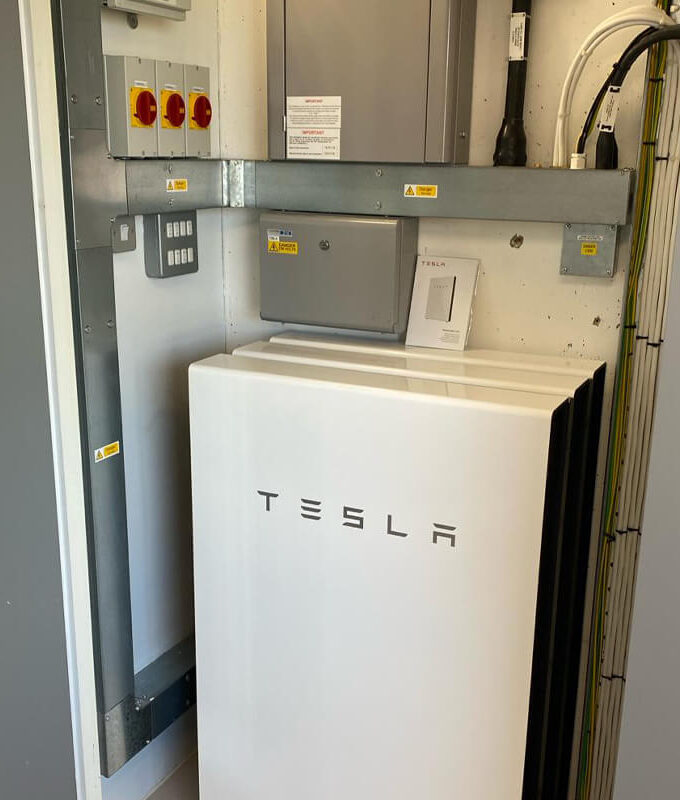
A battery stores surplus solar for the evening, or cheap off-peak electricity for the day, and can keep critical loads running through a power cut. It pays best for sites with evening or night-time demand. See commercial battery storage.
EV charging for fleets and staff
Solar-powered charging at depots and offices is the cheapest motoring a fleet will get. We install workplace EV chargers alongside the solar.
Monitoring and after-care
Every commercial system comes with online monitoring that both you and we can see. Generation is checked against the design figures, and a drop in output shows up before it costs you money.
Tariffs and export
Once the system is in, the right electricity tariff matters: export tariffs pay for what you send to the grid, and off-peak tariffs make a battery work harder. We advise on both as part of the handover.
Commercial solar: your questions
It depends on the size of the system, the roof or ground it goes on and the electrical connection, so we price every project from a site survey. The proposal gives you the cost, the expected generation and the payback in one document. Our Hampshire commercial page gives budget figures for typical system sizes.
In England, rooftop solar on most commercial buildings is permitted development, subject to conditions on how the panels sit on the roof. Systems above 50 kW usually need the council’s prior approval, a lighter-touch process than full planning permission; listed buildings always need consent, and ground-mounted arrays normally need full planning permission. We tell you which applies at the survey and can help with the application. See our guide to planning permission for solar panels.
The installation itself takes days to a few weeks depending on size. The longer wait is usually the district network operator’s connection agreement, which we apply for as soon as you go ahead. We give you a realistic timetable in the proposal.
Most are. We look at the orientation and pitch, the roof covering and its remaining life, the structure’s ability to carry the panels and where the inverters and cabling can run. Flat roofs use ballasted frames; pitched roofs use specialist clamps and fixings. If a roof is not suitable, ground-mounted panels on spare land are often the answer.
If you use most of your electricity in the daytime, the panels alone give the best return. If you have evening or overnight demand, or want back-up for critical equipment, a battery can be worth adding. The energy audit shows which applies to you.
You get a handover pack, staff training on the shut-down procedure and the monitoring portal, and the manufacturers’ warranties. We monitor the system alongside you and can arrange periodic inspections and panel cleaning where a site needs them.
Arrange a free commercial solar survey
Tell us about your premises and your electricity use and we will do the rest: a free site survey, a written proposal with payback figures and a project managed by Infinity from start to finish.
Fill in the form and our commercial team will be in touch to arrange a site survey anywhere in Hampshire and the South. There is no obligation; just a clear proposal you can take to your board. Or call us on 0800 909 8882.
THREE-TIME RENEWABLE AWARD WINNERS



GET YOUR FREE QUOTATION TODAY:
This site is protected by reCAPTCHA and the Google
Privacy Policy and Terms of Service apply.
LATEST NEWS & GUIDES
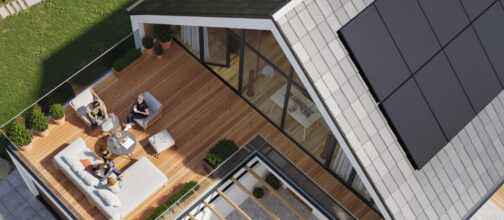
Low-interest, government-backed loans of up to £15,000 for solar panels, £15,000 for a battery and £20,000 for a heat pump. What the Warm Homes Loan Scheme is, what it will really cost and how to apply.

The Boiler Upgrade Scheme explained: grant amounts, the £9,000 rate for oil and LPG homes, who qualifies and how to apply.
SERVICE THAT’S FULLY SUPPORTED, ACCREDITED AND GUARANTEED