
For UK businesses in 2026, commercial solar panels offer a compelling Return on Investment (ROI) of 14-20% or more, with typical payback periods of 4-6 years.
This guide moves beyond simple estimates to provide a detailed financial breakdown for CFOs, directors, and business owners.
We will analyse the critical 2026 UK capital allowances, model the important Capex vs. Power Purchase Agreement (PPA) funding decision, and demonstrate proven ROI with a real UK case study from our award-winning team.*
by David Lewis | published 21 November 2025 | updated 16 January 2026
– TABLE OF CONTENTS –
Executive Summary: Commercial Solar ROI & Payback (The 2026 UK Outlook)
How to Calculate Your Commercial Solar ROI: A Step-by-Step Model
The CFO’s Tax Toolkit: A Guide to UK Solar Capital Allowances
Financing Your Installation: PPA vs. Outright Purchase (Capex)
Beyond Theory: A Proven UK Commercial Solar ROI Case Study
What Other Factors Influence Your Commercial Solar ROI?
Frequently Asked Questions (FAQs) on Commercial Solar ROI
Conclusion: Move from ROI Calculation to a Bespoke Financial Proposal
Executive Summary: Commercial Solar ROI & Payback (The 2026 UK Outlook)
For organisations with high electricity consumption, the financial case for commercial solar is exceptionally strong.
The return is delivered through three main streams: a dramatic reduction in operational expenditure (energy bills), significant tax relief via capital allowances, and a secondary income from exporting surplus power.
Typical Payback Periods (by system size)
The payback period – the time it takes for savings to offset the initial cost – is shortest for larger systems due to economies of scale. Businesses with high 24/7 energy usage, such as manufacturing or refrigeration, will experience the fastest returns.
Typical Return on Investment (ROI) & IRR
While simple ROI is often quoted at 14-20% annually, or higher, this metric can be misleading.
A Finance Director will often be more interested in the Internal Rate of Return (IRR), which accounts for the time value of money and allows for a true “apples-to-apples” comparison against other capital projects.
For well-designed commercial solar projects, an IRR of 10% or more is common.
The 2026 Tax & Funding Landscape at a Glance
The ROI is greatly supported by the current financial landscape:
- Tax Relief: Most businesses can use the £1 Million Annual Investment Allowance (AIA) to deduct 100% of the system’s cost from taxable profits in Year 1.
- Large Investment Relief: For investments over £1M, a 50% First-Year Allowance (FYA) provides significant accelerated relief.
- Rates Exemption: A 10-year exemption from business rates on new rooftop solar installations is in effect until 2035.
- Funding: Businesses can choose between a £0-down Power Purchase Agreement (PPA) or an all-in capital expenditure (Capex) purchase to maximise returns.
How to Calculate Your Commercial Solar ROI:
A Step-by-Step Model
A precise ROI forecast must be bespoke. However, the core financial model favoured by our analysts follows these steps, which you can use to build your own business case.
This is your initial investment. Costs vary based on system size, component choice (e.g. panel and inverter brand), and installation complexity. As a guide, a 100 kWp system may cost between £70,000 and £85,000, and generally pitched-roof installations are more cost effective than flat-roof installations.
This is the primary financial benefit. The calculation is the amount of solar electricity you generate and use on-site (in kWh) multiplied by the ‘avoided cost’ of that electricity (your current blended p/kWh rate from the grid). For example, using 100,000 kWh of your own solar power at an avoided cost of 20p/kWh creates a £20,000 annual saving.
A credible financial model must be realistic. We factor in modest annual costs for maintenance and insurance (e.g. £500-£1,500), as well as a minor annual panel degradation rate of 0.5% or less. This ensures our 25-year forecasts are conservative and trustworthy.
Any surplus electricity you don’t use is automatically exported to the grid, generating a secondary income via the Smart Export Guarantee (SEG). While a welcome bonus, this revenue is typically small compared to the savings from displacing your grid supply. To receive SEG income, you must sign up with a SEG scheme participating energy supplier.
The Simple Payback Formula vs. Lifetime ROI Formula
You can use these two formulae for a top-level calculation:
1. SIMPLE PAYBACK PERIOD:

2. LIFETIME ROI:

The CFO’s Tax Toolkit:
A Guide to UK Solar Capital Allowances
This is the single most powerful lever for accelerating your solar ROI, and the most misunderstood. Conflicting information is common, but the rules for 2026 are clear.
The Myth of ‘Full Expensing’: Why Solar is a ‘Special Rate Asset’
You may have heard that ‘Full Expensing’ allows a 100% deduction on all plant and machinery. This is incomplete advice.
HMRC and UK government guidance classify solar panels as ‘special rate assets’. The 100% ‘Full Expensing’ scheme only applies to ‘main rate’ assets. Therefore, companies cannot claim 100% Full Expensing on solar panels.
However, this does not mean a 100% deduction is unavailable. It is simply achieved through a different, more familiar mechanism.
Tax Strategy 1:
The Annual Investment Allowance (AIA)
For the vast majority of UK businesses, the Annual Investment Allowance (AIA) is the primary tax tool. The AIA limit is permanently set at £1 million.
Solar panels are ‘fully eligible’ for the AIA. This means your business can deduct 100% of the cost of the solar installation (up to the £1M limit) from your pre-tax profits in the year of purchase. At the 25% corporation tax rate, this effectively provides an immediate 25% cash-back on the investment.
Tax Strategy 2:
The 50% First-Year Allowance (FYA)
This strategy is for large-scale investments exceeding the £1 million AIA limit. For any remaining expenditure on special rate assets (like solar panels) above the AIA cap, incorporated businesses can claim a 50% First-Year Allowance (FYA).
You deduct 50% of the excess cost in Year 1. The remaining 50% is then added to your ‘special rate pool’ to be written down at the 6% rate in subsequent years. This is a powerful tool for accelerating tax relief on multi-million-pound projects.
Bonus Incentive: 10-Year Business Rates Exemption
A landmark policy, often overlooked, provides a 100% exemption from business rates for new rooftop solar installations. This scheme, running from April 2023 to 2035, means your investment will not increase your property’s rateable value. Businesses installing in 2026 will benefit from a full 10-year window of this tax relief.
Financing Your Installation:
PPA vs. Outright Purchase (Capex)
The second major question for the board is how to finance the project. This choice fundamentally alters the financial model, cash flow, and risk profile.
Option 1:
Outright Purchase (Capex)
This is the traditional route: your business buys the system outright using its own capital.
PROS
- Maximum ROI: You keep 100% of the energy savings, delivering the highest possible lifetime return after the initial payback period.
- Full Tax Benefits: You are the owner, so your business claims the 100% AIA or 50% FYA tax deductions.
- Full Ownership: The system is a balance sheet asset from day one.
CONS
- High Upfront Cost: Requires significant capital, which could be used elsewhere.
- Maintenance Risk: You are responsible for all ongoing maintenance and performance risk.
Option 2:
Power Purchase Agreement (PPA)
A PPA is a £0-capital-cost option. A third-party funder designs, installs, owns, and maintains the solar system on your roof. Your business simply agrees to buy the discounted solar electricity from the funder for a fixed term (e.g. 10-25 years).
PROS
- £0 Upfront Cost: Preserves your working capital for other projects.
- Immediate Savings: You benefit from a lower, fixed electricity rate from day one.
- No Maintenance Risk: The PPA provider is responsible for all monitoring, maintenance, and insurance.
- Off-Balance Sheet: Often treated as an operating expense (Opex) rather than a capital asset, which can be an accounting advantage.
CONS
- Lower Lifetime ROI: You share the savings with the PPA provider, so your total return is lower than a Capex purchase.
- Long-Term Contract: You are locked into a 10-25 year agreement.
- No Tax Benefits: The PPA provider owns the asset and claims the capital allowances.
PPA vs. Capex: A Financial Model Comparison
This table illustrates the decision your Board will need to make for a typical 100 kWp system:
Beyond Theory:
A Proven UK Commercial Solar ROI Case Study
Theoretical numbers are important for modelling, but proven results build confidence. As a multi-award-winning installer, we anchor all our forecasts in real, delivered projects.
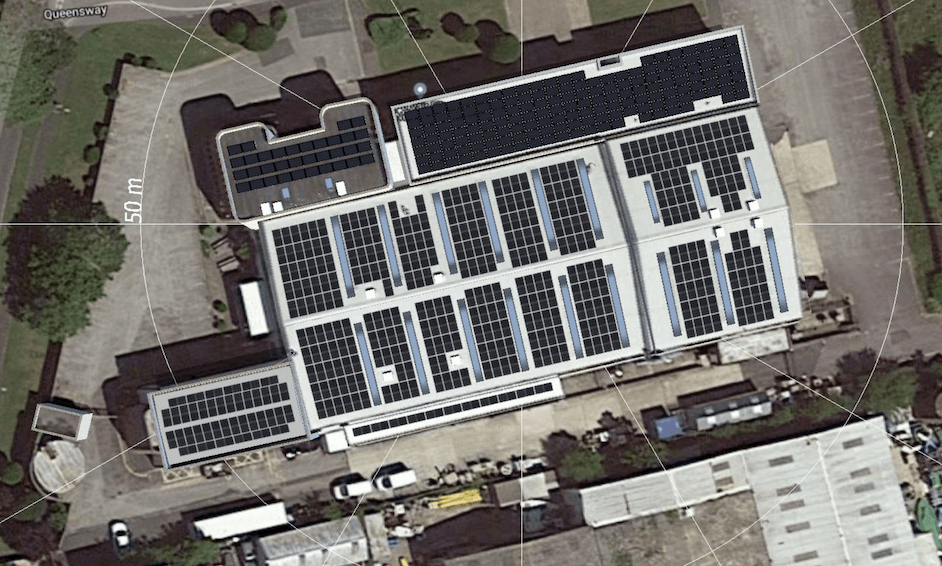
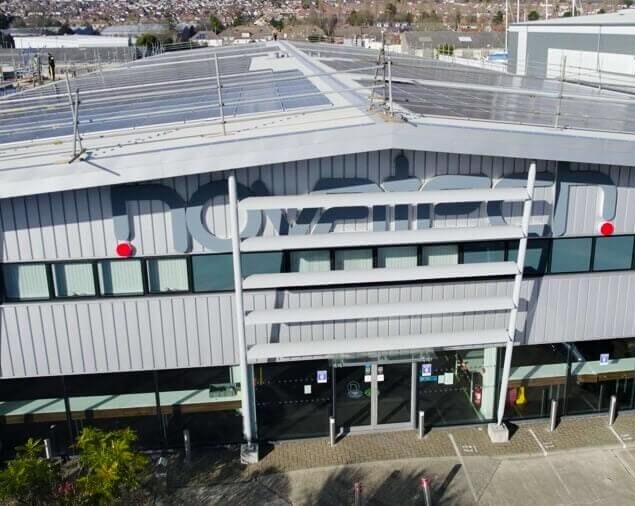
Client: Novatech, Portsmouth
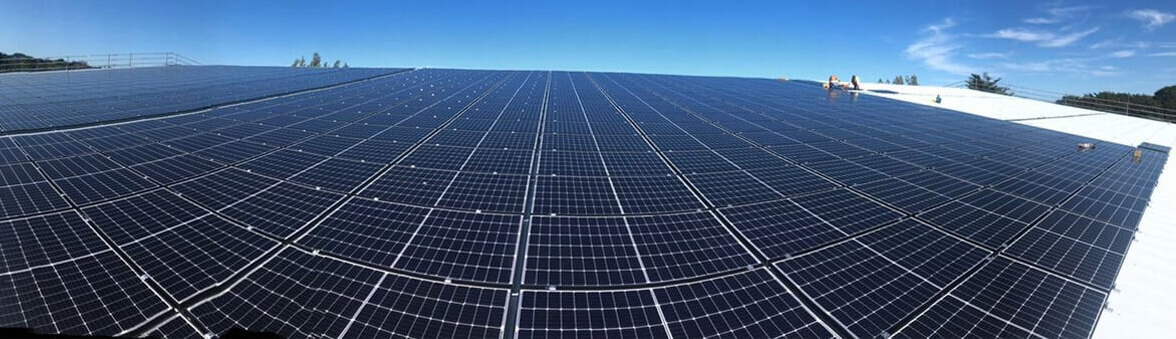
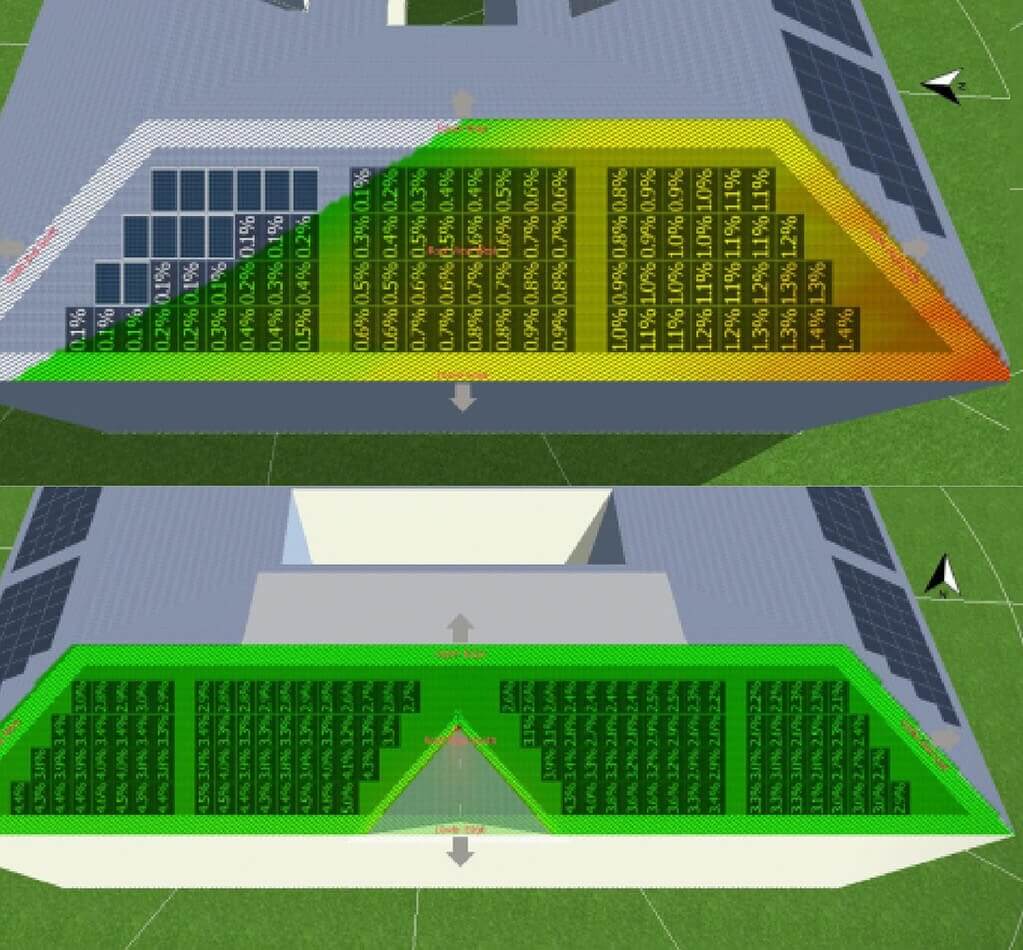
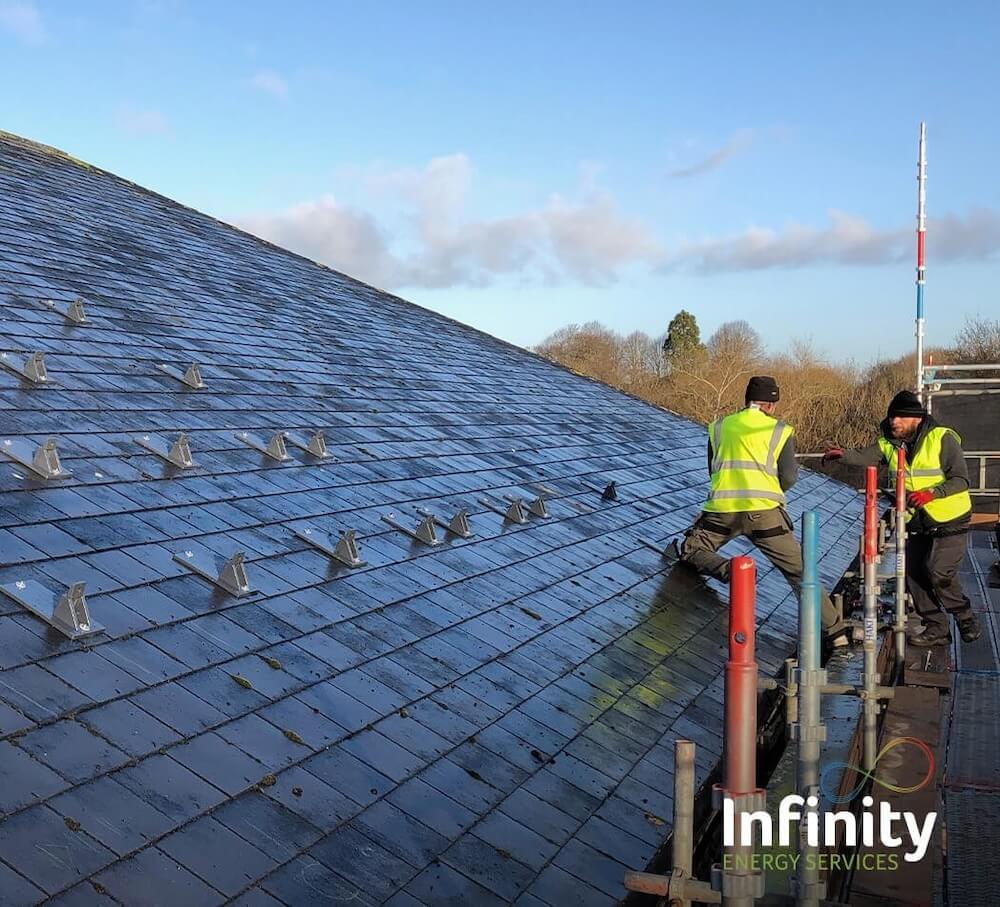
Infinity Energy Services was commissioned to design and install a bespoke 404.3 kWp solar PV installation on the large roof space of this major UK tech supplier.
The Result: £52,297 Annual Saving & 4.0 Year Payback
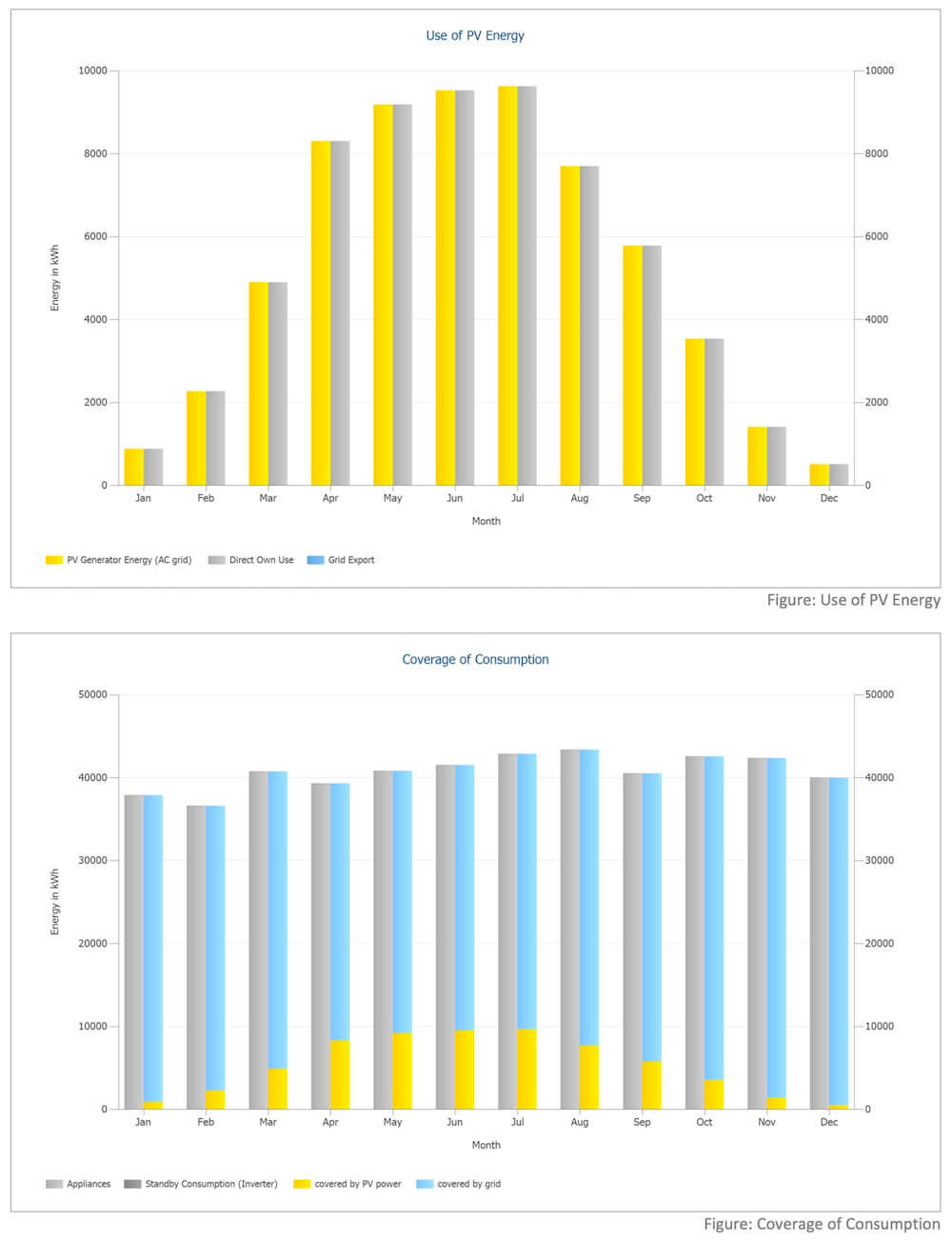
This isn’t a theoretical estimate. The system we installed for Novatech resulted in an immediate annual electricity bill saving of £52,297. This delivered a 4-year payback period and a projected profit of £1,101,356 after 20 years. This is the tangible, proven ROI we deliver for our clients.
What Other Factors Influence
Your Commercial Solar ROI?
Your bespoke forecast will depend on several key variables specific to your site and operations.
1. UK Location & Roof Orientation/Pitch
The direction (south-facing is optimal) and angle of your roof, as well as any shading from nearby objects, will determine the total annual energy generation.
2. Your Current Electricity Tariff & Usage Profile
The higher your current electricity rate (p/kWh), the greater your savings. Businesses with a high, consistent energy usage profile (e.g. 24/7 manufacturing, refrigeration, or data centres) see the fastest ROI because they use almost all the solar energy they generate on-site.
3. System Size & Component Quality
Larger systems benefit from economies of scale, reducing the cost-per-kW and shortening the payback period. Using higher-efficiency panels, while costing more upfront, can maximise generation and improve lifetime ROI, especially on space-constrained roofs.
4. Ongoing Maintenance Schedule
While solar panels require minimal maintenance, a regular cleaning and inspection plan ensures the system operates at peak efficiency for its entire 25+ year lifespan, protecting your ROI.
Frequently Asked Questions (FAQs)
on Commercial Solar ROI
A good ROI is typically 10-20% or more, with most businesses achieving a full payback on their investment in 4-6 years.
Simple ROI calculates total profit as a percentage of cost. IRR is a more sophisticated metric used by finance professionals, calculating the project’s true annual rate of return over its lifespan. It accounts for the time value of money, which allows it to be accurately compared against other potential capital investments.
Yes. Studies and market data show that commercial properties with solar panels and improved EPC ratings sell for more. The installation is seen as a valuable asset that reduces operating costs for future owners or tenants.
Yes, though it is a secondary benefit. The SEG provides a small but valuable income stream for exporting any unused electricity. However, the primary financial benefit (by a factor of 3-4x) always comes from displacing your own high-cost grid electricity.
While large-scale direct grants are rare, the primary government incentives are delivered via the tax system. These are extremely valuable and include the 100% deduction via the Annual Investment Allowance (AIA), the 50% First-Year Allowance (FYA) for major projects, and the 10-year exemption from business rates.
Conclusion: Move from ROI Calculation to a Bespoke Financial Proposal
The Return on Investment for UK commercial solar in 2026 is robust, predictable, and accelerated by powerful tax incentives.
A payback period of 4-6 years is not just possible, but typical.
However, the true value and fastest payback are unlocked by expert engineering, accurate tax planning, and the correct funding model for your balance sheet.
Stop guessing your ROI. Our multi-award-winning team (2024 Solar PV Contractor of the Year) can provide a bespoke, data-driven financial proposal for your business, incorporating battery storage and EV chargers, where appropriate.
Contact us today for a free, no-obligation energy audit and detailed ROI forecast, modelled specifically for your energy profile and tax position. We install solar panels for businesses in Hampshire and the surrounding counties. We can tailor your system to match the needs of your specific sector. For example, we install bespoke systems for Hampshire farms, as well as high-yield installations for energy intensive industries.

* Please note: Nothing in this guide constitutes financial advice and you should always consult a financial professional before making a decision to buy, lease or finance a solar panel system.