
Octopus Energy Slashes EV Charging Rates from April 2026

Some customers will pay as little as
3.49p per kWh
published 23 March 2026
Electric vehicle owners across the UK are set to benefit from significantly cheaper home charging from 1 April 2026, as Octopus Energy applies government-mandated policy cost reductions to its popular EV tariffs. Off-peak rates on the Intelligent Octopus Go and Octopus Go tariffs are falling by up to 39%, bringing overnight charging costs to some of the lowest levels ever seen on the UK energy market.
The reductions are being driven by the UK government’s decision – announced in the November 2025 Budget – to remove approximately £150 of green levy costs from household energy bills. Ofgem confirmed the April 2026 energy price cap at a reduction of around £117 (approximately 7%) for a typical dual-fuel home, and Octopus has committed to passing these savings on to all customers, including those on fixed-rate tariffs.
What Are the New Rates?
Octopus Energy offers two dedicated EV tariffs – Intelligent Octopus Go and the simpler Octopus Go – both of which feature a cheap overnight window for home charging. From 1 April, the off-peak rates on both tariffs are falling substantially.
The following table shows the current and new rates for Hampshire, based on the 12-month fixed tariffs available from Octopus at the time of writing. Rates vary by region across the UK, so EV owners in other areas should check the Octopus website for their specific figures.
TARIFF | GO - CURRENT | GO - APRIL | INTELLIGENT GO - CURRENT | INTELLIGENT GO - APRIL |
Off-peak window | 00:30 to 05:30 | 00:30 to 05:30 | 23:30 to 05:30 | 23:30 to 05:30 |
Night rate (p/kWh) | 10.5p | 6.99p | 9p | 5.49p |
Day rate (p/kWh) | 37.22p | 33.71p | 37.22p | 33.71p |
Standing charge | 46.48p/day | 46.48p/day | 46.48p/day | 46.48p/day |
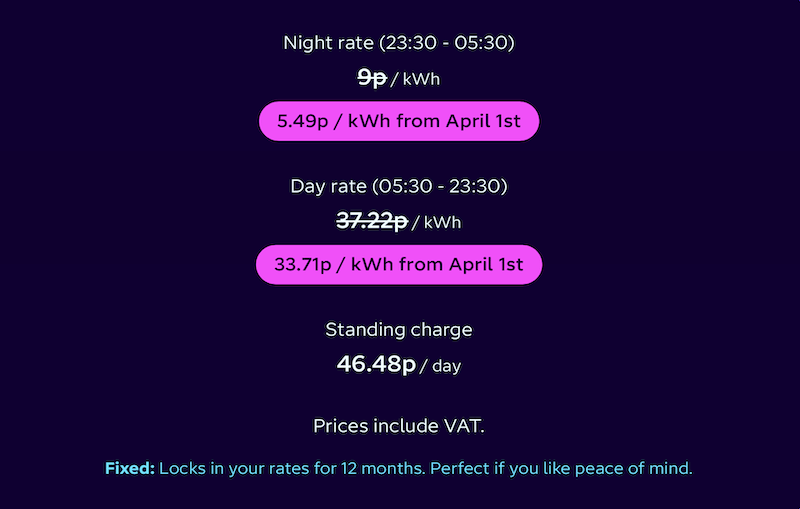
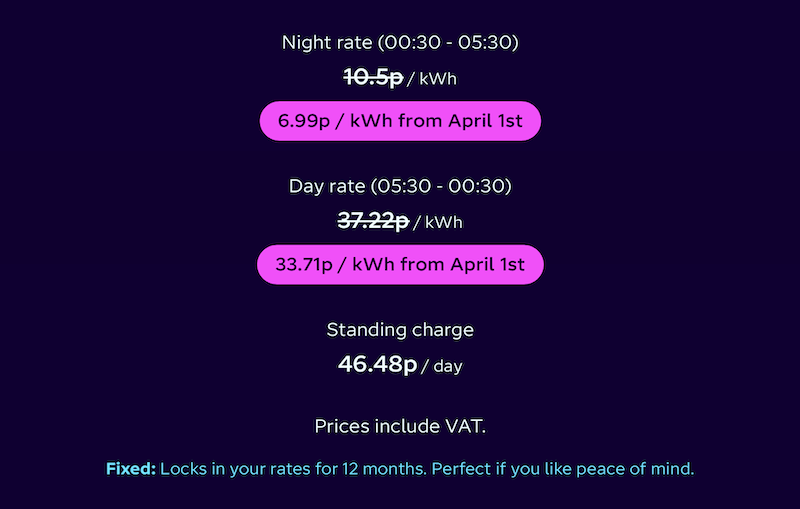
The headline figures are striking. On Intelligent Octopus Go, the off-peak rate falls from 9p to 5.49p per kWh – a reduction of 39%. On Octopus Go, the night rate drops from 10.5p to 6.99p per kWh – a 33% reduction. Both tariffs also see the daytime rate fall by 3.51p per kWh, from 37.22p to 33.71p.
It is worth noting that Octopus is currently only offering fixed-rate versions of both tariffs, which lock in rates for 12 months. Variable-rate customers may see slightly different figures when their rates are updated.
Below we display the 1 April rates for a Hampshire postcode using the official Intelligent Go and Go Rate finders:
Intelligent Octopus Go Rates
1 April 2026
Octopus Go Rates
1 April 2026
Some Customers Could Pay as Little as 3.49p per kWh
Rates vary by region across the UK, and some Intelligent Octopus Go customers are set to pay even less than the Hampshire figures quoted above. Reports have emerged on EV owner forums of customers receiving emails from Octopus confirming a fixed Intelligent Octopus Go off-peak rate of just 3.49p per kWh from 1 April, alongside a peak rate of 24.95p and a standing charge of 45.42p per day. Other customers have reported being quoted an Octopus Go off-peak rate of 4.99p per kWh for the same period.
These lower rates appear to reflect regional pricing differences – Octopus sets its tariffs according to 14 distribution network operator (DNO) regions across the UK, and the cost of delivering electricity varies from one area to another. The pattern is consistent: off-peak rates are falling by roughly 3.5p per kWh across all regions, but the starting point differs, meaning some areas will see off-peak rates below 4p per kWh while others will be closer to the 5.49p to 6.99p range shown in the Hampshire example.
EV owners can check the specific rates available in their area by entering their postcode on the Octopus Go or Intelligent Octopus Go pages on the Octopus Energy website.
Why Are Rates Falling So Sharply?
The reductions are primarily the result of two government policy changes taking effect from 1 April 2026. First, the Energy Company Obligation (ECO) scheme – which required energy suppliers to fund energy-efficiency upgrades for vulnerable households – has been scrapped entirely, removing approximately £60 from annual energy bills. Second, the government is shifting 75% of the costs associated with the Renewables Obligation to general taxation until at least 2029, saving households a further £66 per year.
These policy costs are applied to the unit rate rather than the standing charge. Because EV tariff off-peak rates start from a much lower base than standard tariffs, the removal of approximately 3.5p per kWh in policy costs has a proportionally dramatic effect – turning a 9p rate into a 5.49p rate, for example.
Octopus has confirmed that it will pass the full policy cost savings on to all customers automatically from 1 April, regardless of whether they are on a fixed or variable tariff. Fixed-rate customers may in fact see slightly larger savings, as they are insulated from other cost increases – such as rising network charges – that partially offset the savings for variable-rate customers.
What Does This Mean in Practice for EV Owners?
The savings for EV owners who charge at home during off-peak hours are considerable. A typical electric vehicle covering 7,100 miles per year, with an average efficiency of around 3.3 miles per kWh, consumes roughly 2,150 kWh of electricity annually for charging.
On the current Intelligent Octopus Go off-peak rate of 9p per kWh, that equates to approximately £194 per year. At the new April rate of 5.49p per kWh, the same charging would cost approximately £118 per year – a saving of around £76 annually on charging costs alone.
For context, the average cost of charging the same vehicle using public charging points – at around 54p per kWh – would be approximately £1,161 per year. Home charging on Intelligent Octopus Go at the new 5.49p rate therefore represents a saving of over £1,000 per year compared with relying solely on public chargers.
The off-peak window also benefits the whole home, not just EV charging. Any electricity used during the overnight hours – for example, running a dishwasher, washing machine or charging a home battery – is billed at the same discounted rate. Households that pair an EV tariff with a battery storage system can charge the battery overnight at the cheap rate and use that stored energy during the day, further reducing their overall electricity costs.
Intelligent Octopus Go vs Octopus Go – Which Tariff?
There are two important differences between the tariffs that EV owners should consider.
- Intelligent Octopus Go offers the lower off-peak rate (5.49p vs 6.99p from April) and a longer cheap window of six hours, running from 23:30 to 05:30. The tariff uses the Octopus app to automatically schedule EV charging at the cheapest times, so the car is always ready when the owner needs it. Any smart-scheduled charging is billed at the off-peak rate, even if Octopus moves it outside the standard overnight window. However, it requires a compatible EV or smart charger – currently supporting over 280 vehicle models and chargers from brands including Ohme, Zappi, Hypervolt, Indra, Andersen and Wallbox.
- Octopus Go is the simpler option. It works with any electric vehicle and any home charger, with no app-based scheduling required. The off-peak window is five hours, running from 00:30 to 05:30, and the night rate is slightly higher at 6.99p from April. It suits EV owners who prefer a straightforward setup – simply set the car or charger to charge during the off-peak window – or whose vehicle is not yet compatible with Intelligent Octopus Go.
Both tariffs require the homeowner to have a smart meter and to be an Octopus Energy electricity customer.
Other Changes to Be Aware Of
Alongside the rate reductions, Octopus has been rolling out a six-hour cap on discounted smart charging for Intelligent Octopus Go customers during 2026. Under this change, up to six hours of smart-scheduled EV charging per 24-hour period is billed at the off-peak rate. If a charge session exceeds six hours, any additional time is billed at the standard daytime rate. Around 80% of Intelligent Octopus Go charging sessions already fall within six hours, so the change will not affect the majority of users, but EV owners with very large batteries or slower chargers should be aware of the limit.
Octopus is also introducing a Charge Cap feature within its app, giving customers the choice between capping their charge at six hours or prioritising reaching their target battery level – with a notification if additional charging outside the cheapest hours is needed.
How Long Will These Rates Last?
The government has committed to keeping the green levy reductions in place until at least 2029, so the underlying policy cost savings should be a long-term feature of energy bills rather than a one-off quarterly dip. However, other components of the energy price – including wholesale costs and network charges – will continue to fluctuate. Ofgem reviews the price cap quarterly, and variable tariff rates are adjusted accordingly.
For customers on the current 12-month fixed versions of these tariffs, the April rates will be locked in for the duration of the fix. Octopus has stated that it does not typically apply exit fees to its fixed tariffs, giving customers the flexibility to switch if better rates become available.
The Bigger Picture for EV Adoption
Cheaper home charging strengthens the financial case for switching to an electric vehicle. At 5.49p per kWh, the cost per mile for a typical EV on Intelligent Octopus Go works out at under 2p – compared with approximately 14-15p per mile for a petrol car. For households that also have a solar panel and battery storage system, the economics are even more favourable, as solar-generated electricity can be used during the day while cheap overnight grid power handles EV charging and battery top-ups.
The April 2026 rate changes arrive at a pivotal time for the UK’s EV market, with the government’s Zero Emission Vehicle (ZEV) mandate requiring manufacturers to ensure that a growing proportion of new car sales are fully electric. Lower running costs make the transition more attractive for drivers who have been hesitant about making the switch.
Want to know more about the latest Octopus Energy Rates?
Infinity Energy Services is an MCS-certified, RECC-member installer of solar panels, battery storage, heat pumps, and EV charging points across nine counties in the South, and we’ve been helping homeowners since 2011. If you’re thinking about making energy-efficient improvements to your home and want to understand how Octopus Energy’s EV tariffs can help reduce costs, please get in touch on 0800 909 8882.
Installation near you
Choose your county for local details: Hampshire · Dorset · Wiltshire · Berkshire · Surrey · West Sussex · Somerset · Gloucestershire · Oxfordshire.
We only install in these counties, so please check yours is listed before you enquire.