
The Clocks Go Back on Sunday: How to Run Your Home on Cheap Overnight Electricity This Winter

published 22 October 2026
The clocks go back at 2am on Sunday 25 October. From then until spring, the 4pm-7pm evening peak falls in the dark.
That’s when electricity costs the most, and when your solar panels can’t help.
Here’s how a home battery and the right tariff let you run your evenings on cheap overnight electricity instead.
Below, we cover the best tariffs, how to set your battery for winter and what it could save you.

Why the clock change matters for your electricity bill
The clocks go back one hour at 2am on Sunday 25 October, when British Summer Time ends. In Southampton, sunset moves from just before 6pm on Saturday to just before 5pm on Sunday. By mid-December, the sun is down by about 4pm.
That matters because the early evening is when electricity is busiest and most expensive. Many smart tariffs, including Octopus Flux and Cosy Octopus, charge a peak rate from 4pm to 7pm: exactly when you get home, cook, turn the heating up and switch the lights on. From now until spring, solar panels stop generating before that peak even starts.
So in winter, the question isn’t really how much your panels produce. It’s where the electricity you use after dark comes from, and what you pay for it.
Your battery’s winter job: fill up overnight, run the evening
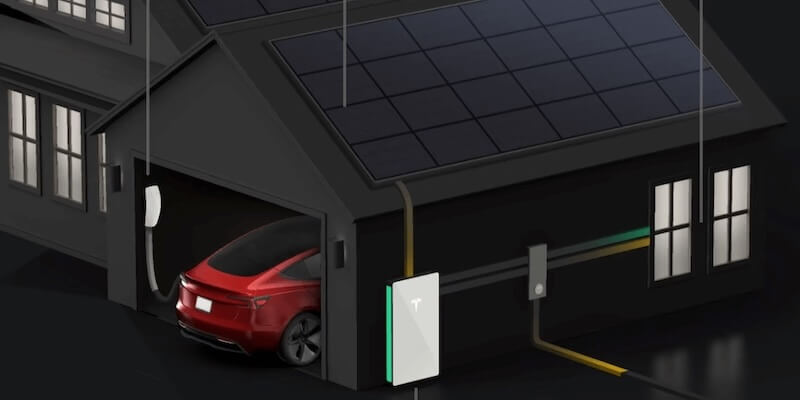
In summer, a home battery mostly stores spare solar power from the middle of the day. In winter there’s far less spare solar to store, so the battery takes on a different job. It charges from the grid overnight, when electricity is cheapest, then runs your home through the evening peak and into the next day.
It’s a simple swap. Instead of buying electricity at 26p to 37p per kWh in the evening, you buy it at roughly 9p to 16p per kWh overnight (see the tariffs below) and store it until you need it. Any solar you do generate on bright winter days is a bonus on top.
Two things decide how well this works:
- The gap between your cheap rate and your normal rate. The bigger the gap, the more each overnight kWh saves.
- The size of your battery. A battery only saves money on the electricity it can hold. A Tesla Powerwall 3 stores 13.5 kWh, which is more than a typical home uses in an evening.
Some energy is lost as a battery charges and discharges. Tesla quotes 89% efficiency for solar energy stored in Powerwall 3 and then used in the home, and we’ve used the same figure for overnight charging from the grid. That means about 11 kWh from the grid gives you about 10 kWh to use, and our worked example below allows for this.
Setting your Powerwall 3, SigenStor or Fox ESS for winter
All three batteries we install can be set to charge from the grid at times you choose:
- Tesla Powerwall 3: enter your tariff’s cheap and peak times in the Tesla app, and Powerwall charges from the grid when prices are low.
- Sigenergy SigenStor: set a charging schedule for your off-peak hours in the mySigen app.
- Fox ESS: use the scheduler in the Fox ESS app to set a “force charge” period overnight.
In midwinter, filling the battery overnight usually makes sense. In spring and autumn, it’s worth leaving some room on sunny days, so free solar power has somewhere to go.
Thinking about Battery Storage?
Choose the option that best matches your situation and we’ll take you to our interactive calculator where you can discover typical costs and savings.
Personalised to your home · Free to use · No obligation
What’s the best tariff for solar and battery homes this winter?
You can only be on one import tariff at a time, so the best one for you depends on what you have: solar panels, a battery, an electric car or a heat pump. Here are the main types. The rates are for Southern England, the region that covers Hampshire, on 22 October 2026, from Octopus Energy’s published tariff data. Household electricity carries no VAT until 31 March 2027, after the government’s temporary VAT cut.
Octopus Flux: for homes with solar panels and a battery
Octopus Flux has three rates: a cheap rate from 2am to 5am (16.09p per kWh), a peak rate from 4pm to 7pm (37.20p) and a day rate the rest of the time (26.65p). Octopus recommends charging your battery in the 2am-5am window. Flux also pays more for electricity you export at peak times (30.16p per kWh from 4pm to 7pm), which helps on bright days in spring and summer. You need solar panels, a home battery and a smart meter. Octopus also offers Intelligent Octopus Flux, which controls compatible batteries for you.
Electric car tariffs such as Octopus Go
If you have an electric car, an EV tariff usually has the cheapest overnight rate, and on many of them the cheap rate covers your whole home, battery included. Octopus Go, for example, charges 9.40p per kWh from 12.30am to 5.30am, but 34.81p at other times. On a tariff like this, a battery that carries you through the day is what makes it pay.
Cosy Octopus: for heat pump homes
Cosy Octopus gives eight hours of cheap electricity a day, in three windows: 4am-7am, 1pm-4pm and 10pm-midnight. Octopus says these are 51% cheaper than the day rate in your region, while the 4pm-7pm peak is 50% above it. You need a heat pump, electric radiators or an electric boiler. With a battery, you can charge in the cheap windows and avoid the peak altogether.
Economy 7 and other overnight tariffs
Economy 7 tariffs from many suppliers give seven hours of cheaper electricity overnight. Times and rates vary by supplier and region, and the gap between the day and night rates can be smaller than on newer smart tariffs, so check the numbers before you switch.
Confused by home energy tariffs?
Tell us which technologies you have – choose as many as you like – to find the ideal tariff for your home.
Independent of any supplier · Free to use · No obligation
A winter day in numbers
Here’s a simple example for a Hampshire home on a dull December day, when solar panels produce very little. The home uses 10 kWh of electricity between 7am and midnight, including 3 kWh during the 4pm-7pm peak. With a battery, it charges about 11.2 kWh overnight (to allow for the energy lost in the battery) and runs on the battery for the rest of the day. Standing charges are left out, because they vary by tariff.
How the home is set up | Electricity cost for the day |
No battery, on the price cap rate (26.32p per kWh) | £2.63 |
No battery, on Octopus Flux | £2.98 |
Battery charged 2am-5am on Octopus Flux (16.09p) | £1.81 |
Battery charged 12.30am-5.30am on Octopus Go (9.40p, for EV homes) | £1.06 |
Compared with the price cap rate, that’s a saving of about 82p a day on Flux and about £1.58 a day on Go. Over a four-month winter of 120 days, that adds up to roughly £99 and £189. Notice that Flux without a battery costs more than the price cap here, because of its peak rate. Flux is a tariff for battery homes.
These figures are an illustration, not a quote. What you save depends on how much electricity you use and when, the size of your battery and the rates in your area.
Heat pump and battery: heat when it’s cheap, coast through the peak
Winter is when a heat pump uses most of its electricity, so the timing of that electricity matters most. A few simple changes make a real difference:
- Heat your hot water cylinder in a cheap window – overnight or, on Cosy Octopus, between 1pm and 4pm – rather than in the evening.
- Let the heat pump warm the house a little more before 4pm, so it can ease off during the peak.
- Let the battery run the heat pump and the rest of the house from 4pm to 7pm.
If you’re thinking about a heat pump, our page on heat pump installers in Hampshire explains how the Boiler Upgrade Scheme works. To see what one would cost to install and run in your home, try the calculator below.
How do you heat your home today?
Select your current heating, and discover heat pump installation and running costs compared to what you have now, and any grants you can claim.
Free to use · Grants checked against official schemes · No obligation
Already have solar panels but no battery?
Many people who had solar panels fitted years ago find the panels do little for their winter bills. A battery changes that, because it lets you store cheap overnight electricity as well as your own solar power. Solar panels and batteries for homes are VAT-free until 31 March 2027, and that includes a battery added to an existing system.
If you’re still on the old Feed-in Tariff, it’s worth checking how a battery and a new export tariff would fit with your existing payments before you buy. Our free Battery Retrofit Checker looks at your existing system and tells you whether adding a battery makes financial sense.
Our view at Infinity Energy Services
Overnight charging is the biggest single change you can make to a battery’s winter savings. On a dull December day, a battery charged on a cheap rate can do more for your bill than the panels on your roof.
It isn’t magic, though. It only pays when the gap between your cheap rate and the rate you’d otherwise pay is bigger than the energy lost in the battery. With 89% efficiency, electricity bought at 16.09p overnight effectively costs about 18p by the time you use it. That’s still well below a 26p day rate or a 37p peak. Tariffs also change, so check yours every few months rather than setting it and forgetting it.
A battery won’t make winter free, either. Even a 13.5 kWh battery won’t cover every kWh in a home with a heat pump on a cold day. You’ll still buy electricity; you’ll just buy more of it at the cheap rate. And while a battery without solar panels can still use cheap overnight rates, the case is strongest when it does both jobs: storing free solar power from spring to autumn and cheap grid electricity in winter. That’s one reason more than 95% of our solar customers now add a battery.

Next steps
Want to run your home on cheap overnight electricity this winter? We can help you choose the right battery, and the right size, for your home.
Infinity Energy Services has been installing solar since 2011. We’re MCS-certified, a Tesla Powerwall Premium Installer for 2026 and members of the RECC Assurance Scheme, and every project starts with a free survey and a fixed, no-obligation quote.
Fill in our contact form and we’ll be in touch, or call us on 0800 909 8882.